



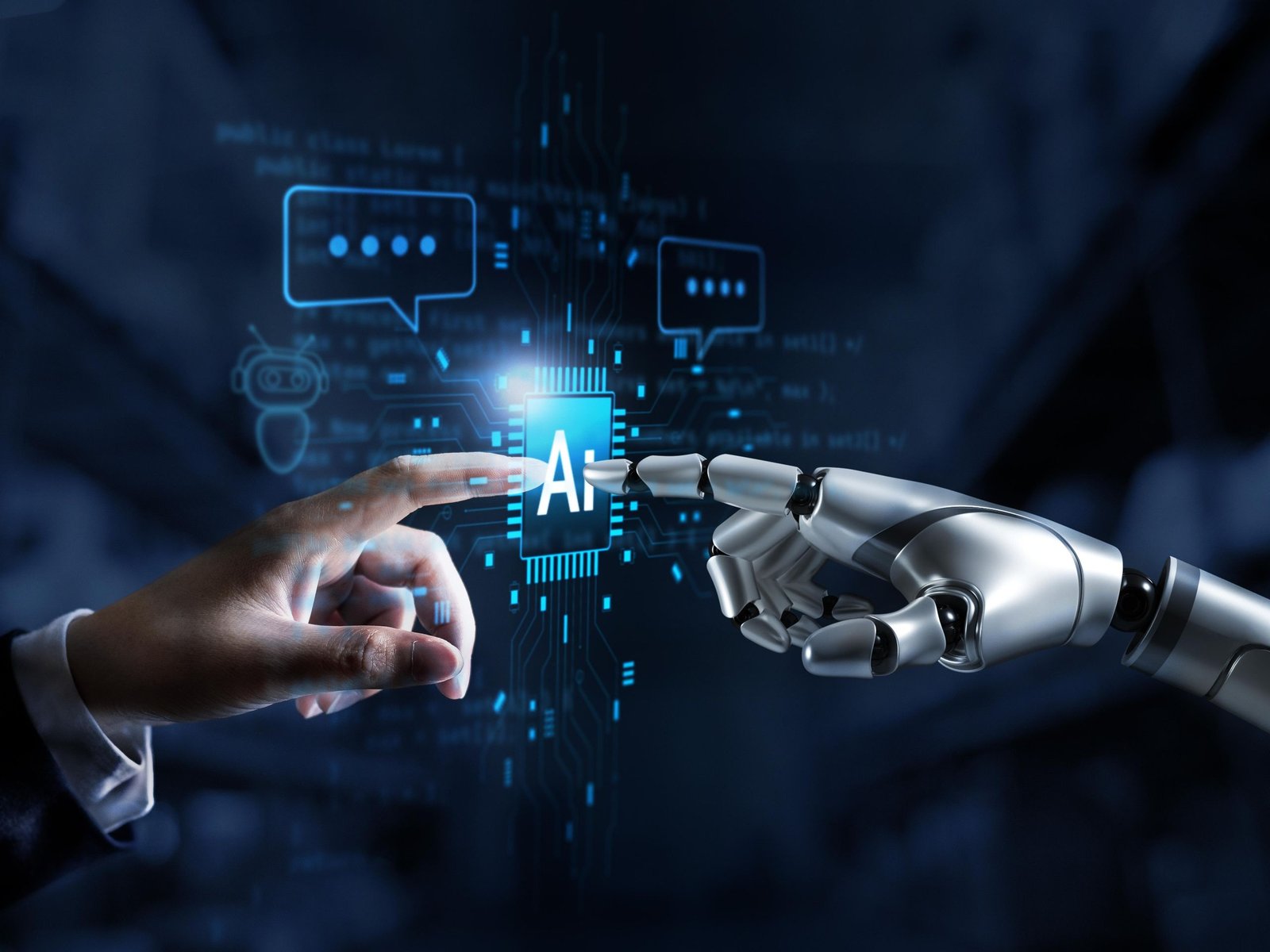
Artificial intelligence has moved far beyond its early role as a specialized computing technology. Today, AI is becoming a fundamental part of how people work, communicate, create, analyze information, and solve complex problems. Traditional computing depends heavily on explicit instructions, predefined rules, and structured data. Modern AI, however, introduces systems that can learn from information, recognize patterns, generate content, adapt to changing circumstances, and assist with decisions. This transformation represents a new age of intelligence in which computing is no longer limited to simply following commands.
Understanding the Evolution of Artificial Intelligence
Traditional computers are exceptionally effective at performing clearly defined operations. A programmer provides instructions, the machine processes them, and the system produces an expected result. This model has powered decades of technological progress, from business software and scientific simulations to smartphones and global communication networks.
AI changes this relationship between humans and machines. Instead of requiring every possible instruction to be programmed manually, many AI systems learn patterns from large collections of data. Machine learning enables software to improve its performance by identifying relationships within information. Deep learning takes this concept further by using complex neural networks to process images, language, audio, and other forms of data.
Generative AI has introduced another major shift. These systems can create text, images, software code, audio, and other forms of content based on learned patterns. As a result, AI is increasingly becoming a creative and collaborative technology rather than simply an automated calculator.
Intelligence Beyond Traditional Computing
One of the most important characteristics of modern AI is its ability to work with information that is difficult to represent through conventional rules. Human communication is an excellent example. Language contains context, ambiguity, tone, cultural references, and implied meaning. Traditional software generally requires explicit rules to process such complexity, while advanced AI models can identify linguistic patterns across enormous datasets.
AI can also analyze unstructured information at a scale that would be difficult for humans to manage manually. Images, documents, videos, customer conversations, scientific papers, and sensor readings can all contain valuable information. Intelligent systems can examine these sources, identify patterns, summarize findings, and support users in making sense of complex material.
This does not mean AI possesses human intelligence in every respect. Rather, it demonstrates that computational systems can perform increasingly sophisticated forms of pattern recognition, prediction, generation, and reasoning.
The Rise of Learning Machines
The transition from programmed software to learning-based systems is central to the new AI era. Instead of defining every rule, developers can train models using examples. The model identifies statistical relationships and uses them to make predictions or generate responses when presented with new information.
This approach has transformed numerous industries. In healthcare research, AI can assist with analyzing medical images and identifying patterns in large datasets. In finance, intelligent systems can help detect unusual transactions and evaluate large amounts of market information. In manufacturing, AI-powered monitoring can identify equipment patterns that may indicate maintenance requirements.
Transportation is another important area. AI can process information from cameras, sensors, maps, and other sources to support navigation and automated driving technologies. In agriculture, intelligent systems can analyze environmental conditions and crop data to help improve resource management.
AI and Human Creativity
Perhaps the most visible change brought by modern AI is its influence on creative work. Writing, graphic design, music production, video creation, and software development are increasingly supported by intelligent tools.
AI does not necessarily replace the creative process. Instead, it can become a collaborative partner. A writer may use AI to brainstorm ideas, organize information, or develop an initial draft. A designer can explore different concepts quickly. Programmers can use AI to explain code, identify potential problems, or generate routine components.
This collaboration can reduce repetitive work and allow people to spend more time on judgment, strategy, originality, and refinement. The value of human creativity remains important because successful results often depend on understanding goals, audiences, context, ethics, and cultural expectations.
The Role of AI in Everyday Life
AI has quietly become part of many everyday experiences. Recommendation systems suggest movies, music, products, and articles based on user behavior. Smartphone assistants can understand spoken requests. Email platforms can identify spam and organize messages. Translation technologies make communication across languages easier.
Search engines increasingly use AI to understand the meaning behind questions rather than relying only on exact keywords. Customer service platforms use intelligent systems to answer common questions and route more complicated issues to human representatives.
As AI becomes more capable, these applications are likely to become more personalized and context-aware. Digital tools may increasingly understand user preferences, recognize recurring tasks, and provide assistance before a person explicitly asks for it.
Challenges of the New AI Era
The rapid expansion of AI also creates significant challenges. One major concern is reliability. AI systems can produce inaccurate information, misunderstand context, or generate convincing answers that are not supported by facts. Human oversight therefore remains essential, particularly in high-stakes environments.
Privacy is another important issue. AI systems often depend on large quantities of data, raising questions about how information is collected, stored, processed, and protected. Organizations must establish responsible data practices while complying with applicable laws and regulations.
Bias is also a continuing concern. If training data contains historical or social biases, an AI system may reproduce or amplify those patterns. Developers and organizations need effective testing, monitoring, transparency, and governance to reduce harmful outcomes.
Employment is another area of discussion. AI can automate certain repetitive tasks while creating new opportunities for people with skills in technology, analysis, creativity, and AI management. Rather than viewing the transformation simply as humans versus machines, many industries are likely to experience a combination of automation and human-AI collaboration.
Building Responsible Intelligence
The future of AI will depend not only on technical capability but also on responsible development. Organizations need clear policies governing how intelligent systems are deployed and evaluated. Human review should remain available when automated decisions can significantly affect individuals.
Transparency is equally important. Users should understand when they are interacting with AI and, where appropriate, have access to information about how systems reach conclusions. Security must also remain a priority because increasingly capable AI systems can become attractive targets for misuse and cyberattacks.
Education will play a critical role as well. People need to understand both the possibilities and limitations of AI. Digital literacy can help individuals evaluate AI-generated information, protect personal data, and use intelligent tools effectively.
What the Future May Hold
The next stage of AI development may involve systems that combine language understanding, vision, reasoning, planning, and interaction with digital and physical environments. AI agents could potentially handle sequences of tasks rather than responding to isolated requests. Businesses may use intelligent systems to coordinate workflows, analyze operations, and support strategic decisions.
At the same time, progress will likely require improvements in efficiency, accuracy, security, and transparency. Bigger models alone will not necessarily solve every problem. Researchers are exploring better architectures, specialized systems, improved training methods, and approaches that make AI more reliable and efficient.
The most significant change may therefore be conceptual. Computing is evolving from a technology that primarily executes instructions into one that can interpret information, learn patterns, generate possibilities, and collaborate with people.
Conclusion
The new age of AI represents a major transformation in the relationship between humans and computers. Traditional computing remains essential, but AI expands what machines can accomplish by enabling learning, pattern recognition, natural-language interaction, and content generation. From scientific research and business operations to creative industries and everyday digital experiences, AI is becoming an increasingly important part of modern life.
The future will not be determined solely by how intelligent machines become. It will also depend on how responsibly humans design, deploy, regulate, and use them. When combined with human judgment and creativity, AI has the potential to move computing beyond rigid instructions toward a more adaptive, collaborative, and intelligent technological environment.