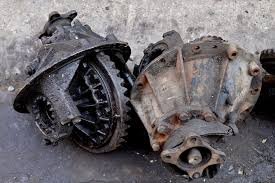
Few sounds are more unsettling than a low whine or growl coming from the rear of your vehicle, especially when it intensifies with speed or turns into a full clunk during acceleration. You might feel vibrations rumbling through the floorboards, notice the car pulling to one side when you apply throttle, see dark oil spots under the differential cover, or spot uneven tire wear creeping in faster than normal. These are textbook symptoms of a failing rear differential—also known as the rear axle assembly in many vehicles. The rear differential takes power from the driveshaft and distributes it to the rear wheels while allowing them to rotate at different speeds during cornering. When bearings wear out, ring and pinion gears get chipped or scored, fluid becomes contaminated, or the unit overheats from heavy towing or aggressive driving, the whole system starts protesting.
Ignoring these signs can lead to catastrophic failure: gears locking up, axles snapping, or a complete loss of drive to the rear wheels, leaving you stranded or creating a dangerous handling situation. Replacing a rear differential is rarely cheap. A brand-new OEM or aftermarket unit can cost $1,500–$4,000+ for the part alone, depending on whether it’s for a daily driver sedan, a full-size pickup like a Ford F-150 or Chevy Silverado, or a heavy-duty 4×4. Remanufactured differentials (rebuilt with new bearings, seals, and possibly gears) usually fall in the $1,200–$3,000 range. Then add professional labor: dropping the old axle, setting precise pinion depth and backlash, adjusting preload, filling with the correct gear oil, and road-testing. Labor often adds $500–$1,500, pushing total repair bills to $2,000–$6,000 or higher in many cases.
This is precisely why so many vehicle owners turn to used auto parts—specifically a quality used rear differential (or complete rear axle assembly)—as the practical, wallet-friendly solution. These components are pulled from salvaged vehicles that were totaled in low-impact crashes, often front-end or side collisions where the rear drivetrain remained completely intact and unstressed. Reputable online marketplaces aggregate inventory from verified salvage yards across the country, allowing you to search by your vehicle’s make, model, year, VIN, and specific requirements like gear ratio (3.55:1, 3.73:1, 4.10:1, etc.), differential type (open, limited-slip, electronic locking), housing material, brake setup (disc or drum), and ABS sensor compatibility.
Used rear differentials typically range from $400–$1,500 shipped, with many listings including free or very low-cost freight to most states. That’s frequently 50–80% less than new or remanufactured options. Listings usually provide transparency: donor vehicle mileage (ideally under 80,000–100,000 miles), clear multi-angle photos of the housing, gears, and fluid condition, inspection notes (no cracks, bearings checked, fluid clean with no metallic glitter), and often a 30-day or longer warranty. Some yards even offer video of the unit being spun on a test stand to confirm quiet, smooth operation.
Real-world examples highlight the savings and reliability. A fleet operator with a 2018 Ram 1500 started hearing a persistent whine after towing trailers regularly. The local transmission and differential shop quoted $4,200 for a remanufactured rear axle installed. Instead, he searched for used auto parts online and found a matching limited-slip rear differential assembly from a 55,000-mile donor truck that had been rear-ended in a minor accident—the rear end was untouched. The part cost $980 shipped with a 60-day warranty. A trusted local shop installed it for $950 (including proper setup, synthetic gear oil fill, and U-joint inspection)—total just under $1,930. The truck has been quiet, smooth, and reliable for over 20,000 miles since, with no vibrations or leaks.
Another driver with a Jeep Wrangler off-roader noticed clunking and pulling during turns. New replacement would have exceeded $3,500 installed. A used rear axle from a low-mileage donor (wrecked in a rollover but rear intact) came in at $720 shipped. Installed for $800—total $1,520. The Jeep handles trails and daily driving perfectly again.
The Bigger Picture: Why Used Auto Parts Online Is the Go-To Strategy
Buying used auto parts online has transformed how people handle repairs. Instead of being limited to whatever happens to be sitting in a local junkyard, you tap into a nationwide network of salvage yards. This means better selection, more accurate fitment (especially with VIN-based searches), detailed condition reports, and the convenience of door-to-door shipping. You can find not just rear differentials but alternators, transmissions, engines, AC compressors, control arms, radiators, doors, headlights—virtually any component—at substantial discounts compared to new OEM or aftermarket equivalents.
Key advantages include:
- Cost savings — Major components like differentials, engines, or transmissions often cost 50–80% less than new or reman.
- Genuine OEM quality — Factory-matched specs, no compatibility surprises or early failures from cheap knockoffs.
- Availability — Ideal for discontinued parts, older models, or specific configurations that dealers no longer stock.
- Transparency and protection — Photos, donor history, test results, warranties (30+ days common), and straightforward returns.
- Environmental impact — Reusing heavy metal assemblies reduces landfill waste, mining demands, and manufacturing emissions.
Tips for Buying and Installing a Used Rear Differential
- Use your VIN — Critical for matching gear ratio, spline count, axle tube width, brake type, and differential style.
- Check the details — Prioritize low-mileage donors, “tested” status, clear photos of gears/housing/fluid, and no visible damage.
- Warranty matters — Look for at least 30 days free coverage; test the unit on arrival by spinning the outputs and listening for roughness or grinding.
- Professional installation — This is not a backyard job for most. A shop will handle axle removal, precise setup (pinion depth, backlash, preload), correct gear oil (often synthetic 75W-90 or 80W-90 with LSD additive if limited-slip), and final road-testing. Budget $500–$1,200 labor.
- While you’re in there — Replace fluid, check U-joints, inspect brakes and shocks, and consider upgrading to a limited-slip if your vehicle sees mud, snow, or towing.
- Red flags — Avoid vague listings without photos or history, extremely high-mileage donors without testing proof, “as-is” no-warranty terms, or prices that seem unrealistically low.
A failing rear differential doesn’t have to mean an expensive new part or trading in your vehicle. Sourcing a used rear differential through used auto parts online gets you reliable, quiet performance at a price that fits most budgets—whether it’s a work truck, family SUV, daily driver, or weekend off-roader. Grab your VIN, search the listings, compare options, and choose the best match. The right used part can save thousands while keeping your ride smooth and dependable for years to come.